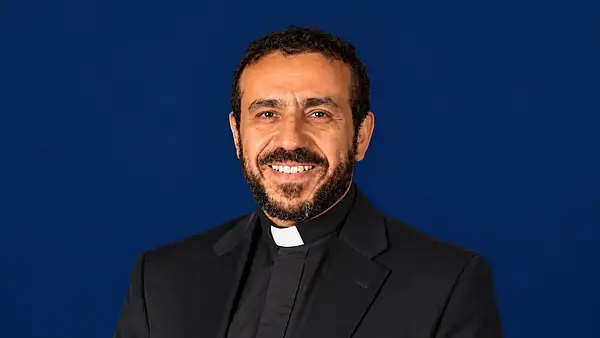
Pope Leo XIV has appointed Fr. Khaled Anatolios, Tantur's Senior Ecumenical Fellow, to the Vatican's International Theological Commission for a five-year term. The University of Notre Dame announced the appointment on 21 October 2026.
Fr. Anatolios is the John A. O'Brien Professor of Theology at Notre Dame and a priest of the Melkite Greek Catholic Church. He joins a body of 30 theologians from around the world who advise the Pope and the Holy See on doctrinal questions of great importance.
For the Tantur community, the news carries a particular joy. The scholar chosen to bring an Eastern Christian voice to the Church's highest theological advisory body is the same scholar who leads Tantur's work of bringing Christian traditions into dialogue.
A new term for the Church's theological advisers
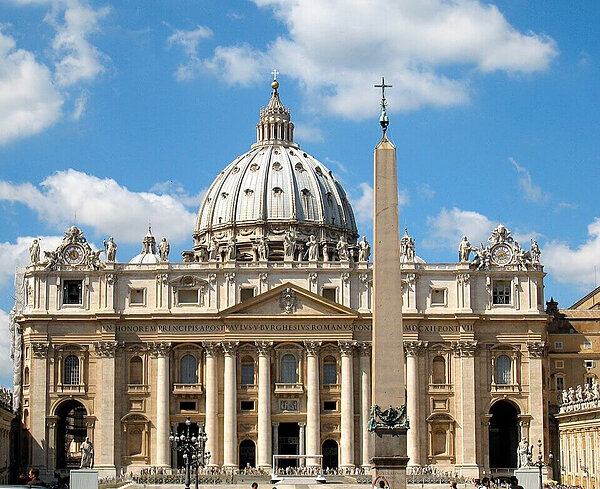
 The International Theological Commission begins its eleventh five-year term (2026–2031) with 30 members. On 19 October 2026, Pope Leo XIV appointed 24 new members and confirmed six from the previous term, including Msgr. Piero Coda as Secretary General.
St. Paul VI established the Commission in 1969, at the request of the 1967 Synod of Bishops. St. John Paul II gave it definitive statutes in 1982. Its task is to study doctrinal questions of major importance and to assist the Holy See, especially the Dicastery for the Doctrine of the Faith, whose Prefect serves as its president. Members are chosen from different theological schools and nations, and they meet in plenary session at least once a year. Over its history the Commission has published 33 documents.
The new membership is more global than before. Asia and Africa now have four members each, South America five, Europe 13, North America three and Australia one. Women on the Commission rose from five to eight, and lay members doubled to eight. The first plenary session of the new term is scheduled for 23–27 November 2026.
According to sources at the Dicastery quoted by EWTN News, the Commission will work in two subcommissions over the coming five years. The first will study Tradition: what it is, where it is found, and how the Church discerns what belongs to it, drawing on biblical, patristic and historical sources. The second will examine how the living Tradition is expressed and handed on through different cultures, including inculturation and popular piety. Both themes touch directly on the patristic scholarship and Eastern Christian perspective that Fr. Anatolios brings.
A theologian formed across three continents
Fr. Khaled Emmanuel Anatolios was born in India and grew up in Egypt and Canada. He is a married priest of the Melkite Greek Catholic Church, an Eastern Catholic Church rooted in the Arabic-speaking Middle East and in full communion with Rome. He serves in the Melkite Eparchy of Newton, in North America.
He studied at the University of St. Michael's College in the University of Toronto (B.A. 1990, M.A. 1992) and earned his doctorate in theology at Boston College in 1996. He taught at Boston College for many years, including in its School of Theology and Ministry, and was a Henry Luce III Fellow in Theology in 2011–2012.
In 2015 he joined the University of Notre Dame as John A. O'Brien Professor of Theology. He chaired the Department of Theology from 2023 to 2026 and is a faculty fellow of the Medieval Institute.
He is the third Notre Dame theologian named to the Commission, after John Cavadini (appointed 2009) and Fr. Yury Avvakumov (appointed 2021).
Reacting to the appointment, Fr. Anatolios said he was humbled by the trust of Pope Leo and the Dicastery. He described it as an opportunity to serve the global Church alongside a diverse group of eminent theologians. Speaking to EWTN News, he praised the Pope's Christocentric vision for engaging the sufferings of today's world, and said he looks forward to entering more deeply into that vision with his fellow members.
Retrieving the Fathers for today's Church
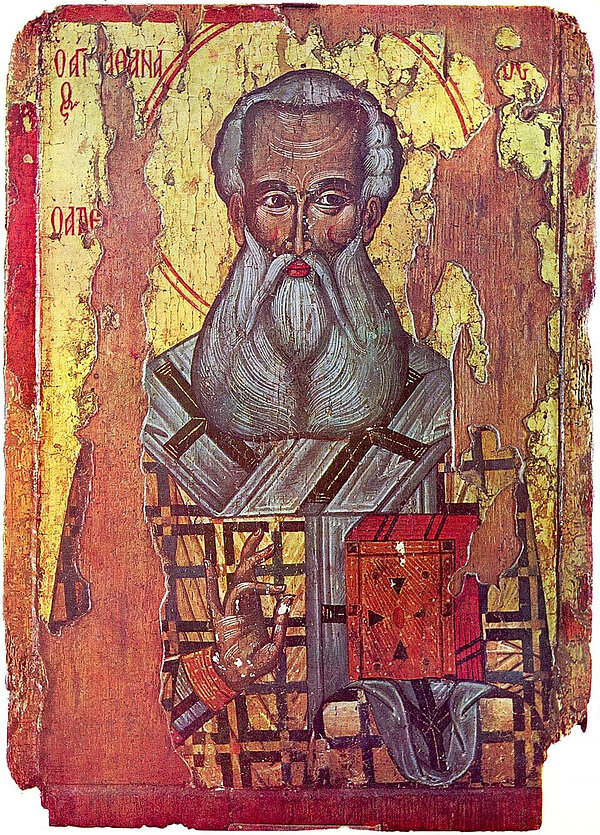
Fr. Anatolios's scholarship centres on the theology of the early Church: the Trinitarian, Christological and soteriological teaching of the Greek Fathers and Augustine, and early Christian biblical interpretation. He has written on Irenaeus, Origen, Athanasius, Augustine and Gregory of Nyssa. A constant thread is how early Christian reflection can speak to contemporary theological questions.
His major books include:
- Athanasius: The Coherence of His Thought (Routledge, 1998) and Athanasius in the Early Church Fathers series (Routledge, 2004).
- Retrieving Nicaea: The Development and Meaning of Trinitarian Doctrine (Baker Academic, 2011). The book traces fourth-century Trinitarian debates through Athanasius, Gregory of Nyssa and Augustine. It argues that the doctrine's meaning is grasped by following how it developed, not by repeating formulas. The Bryn Mawr Classical Review judged it useful to students and advanced scholars alike.
- Deification through the Cross: An Eastern Christian Theology of Salvation (Eerdmans, 2020). Here he proposes "doxological contrition" as a unifying key to salvation: Christ's perfect glorification of the Father joined to his representative repentance on behalf of humanity.
- Feasts for the Kingdom: Sermons for the Liturgical Year (Eerdmans, 2023), a collection of homilies for the Church's feasts.
Deification through the Cross is itself an ecumenical work. Reviewers in First Things and Direction noted how it challenges the old caricature of a "legal" Western soteriology set against an Eastern theology of glory. Drawing on the Byzantine Paschal liturgy alongside Anselm and Aquinas, it shows Greek and Latin traditions bearing a common witness. In 2021, Notre Dame held an ecumenical symposium on the book.
Breathing with both lungs
The appointment brings an Eastern Catholic voice into the Church's doctrinal reflection at a time of intense ecumenical attention to the shared heritage of the early councils. William Mattison, chair of Notre Dame's Department of Theology, recalled St. John Paul II's call for the Church to "breathe with both lungs," East and West. By choosing a Melkite priest, he said, Pope Leo has continued to help the Church do so.
The Melkite Greek Catholic Church carries that vocation in its history. It traces its roots to the ancient See of Antioch and restored full communion with Rome in 1724; its Patriarch, resident in Damascus, also bears the titles of Alexandria and Jerusalem. The Church marked the 300th anniversary in 2024 with a Jubilee titled "an ecumenical journey." Its Holy Synod has stated that, should Catholics and Orthodox be reconciled, the Melkites should be reintegrated into the Orthodox Patriarchate of Antioch.
Fr. Anatolios's work also sits at the heart of a moment the whole Christian world has shared. 2025 marked the 1700th anniversary of the Council of Nicaea, whose Creed is professed by Orthodox, Catholics and most Protestants alike. His Retrieving Nicaea and his recent writing on the normative role of Nicene theology speak directly to that common ground. So does the Commission's new focus on Tradition and its transmission across cultures, a question Eastern and Western Christians answer with distinct but complementary emphases.
A shared vision from St. Paul VI
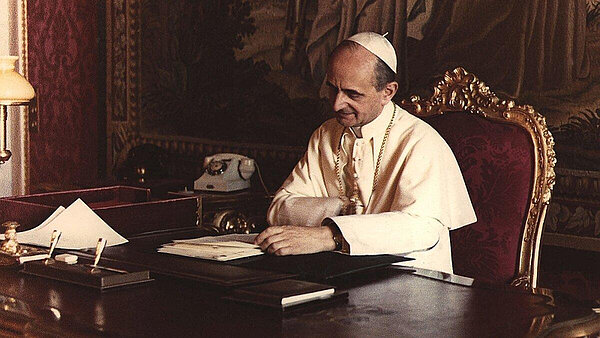
There is a fitting symmetry in this appointment. St. Paul VI created the International Theological Commission in 1969 and, in the same years, conceived Tantur. The Institute opened in 1972 on the hill between Jerusalem and Bethlehem as a place for theological research across denominational boundaries. Both were born of the Second Vatican Council, and both were meant to bring the best theological minds into the service of the Church.
As Senior Ecumenical Fellow, Fr. Anatolios links Notre Dame's Department of Theology with Tantur. He sponsors academic initiatives at both that contribute to the quest for Christian unity. These include:
- The Florovsky Tantur Symposium, a biennial gathering that continues the Florovsky Symposia once held at Princeton. It invites scholars of different traditions to explore core theological themes in light of the Fathers of the undivided Church.
- The Ecumenical Encounters in Systematic Theology Workshop.
- The Righteousness Conference.
During the Nicaea anniversary, he carried that ecumenical work to Anglican, Protestant and academic audiences, speaking at the Receiving Nicaea conference at Pusey House, Oxford, at the Anglican Cathedral of All Saints in Albany, New York, and at an ecumenical dialogue at Alaska Pacific University.
The Tantur Ecumenical Institute warmly congratulates Fr. Khaled on this appointment. We give thanks for his scholarship and his friendship, and we pray that his service on the Commission will bear fruit for the unity of all Christians, for whom, in Tantur's motto, the Light of Christ shines.