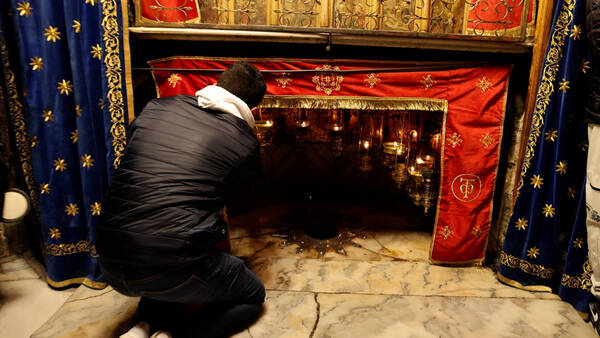
For most pilgrims, the Basilica of the Nativity registers first through the senses. There is the wide parvis outside, then the abrupt, humbling squeeze through the low door. Inside, space opens into columns and painted surfaces, a high roof, and mosaics of angels and councils catching the light as it pours through the windows, sometimes carried on a faint veil of incense. But the basilica’s spiritual focus lies below, in the Grotto of the Nativity: a confined chamber where movement slows into silence and the air is thick with wax and oil. Venerated across the Christian world as the place of the Incarnation, the Grotto is now on the threshold of a long-awaited restoration.
On 23 and 24 January 2026, the Greek Orthodox Patriarchate of Jerusalem and the Custody of the Holy Land publicly confirmed the imminent start of works, undertaken with the cooperation of the Armenian Apostolic Orthodox Patriarchate. In their joint communiqué, the Churches say the project will be carried out “under the auspices of the Presidency of the State of Palestine,” in accordance with a 2024 presidential decree and “the historical Status Quo governing the Holy Places.”
In Bethlehem, that language is not ceremonial. The Status Quo is the legal and liturgical framework that governs shared sanctuaries and blocks unilateral action. In that context, the fact that the custodial Churches are speaking in one voice is itself a concrete ecumenical outcome.
A history layered in stone
The structure above the Grotto reads like a palimpsest. A first basilica was commissioned in the fourth century under Constantine and Helena and dedicated in 339. After its destruction in 529, the complex was rebuilt under Emperor Justinian in 565, giving the church much of its present form. Later centuries, particularly during the Crusader period, added mosaics and decorative elements. The site ultimately became one of the Holy Places regulated by the Status Quo, a system that still governs rights, spaces, and daily practice.
That continuity matters. This restoration is not a stand-alone technical episode. It is an intervention inside a building that has carried nearly seventeen centuries of worship, repair, and cumulative strain.
Scope, governance, and method
The communiqué is measured in tone but specific in scope. It states that the project concerns restoration “in the Grotto of the Nativity” and also includes “technical reinforcement measures in adjacent sections.” In other words, the works are not confined to the devotional focal point alone. They extend to the surrounding structural and circulation zones that support the sanctuary as a whole.
The statement also stresses governance and continuity. The project is anchored in “the historical Status Quo governing the Holy Places” and will proceed “under the auspices of the Presidency of the State of Palestine.” For execution, the Churches point to the Italian firm Piacenti, chosen to ensure “continuity of method, craftsmanship, and artistic sensitivity.” Preparations, they add, are complete and the works are now “on the threshold of commencement.”
Before restoration, removal
Before visitors see equipment or any obvious intervention, the first visible change is subtraction. Terresainte.net reports that textiles and decorative elements are being removed by each community according to its established rights and liturgical practice. The effect is a Grotto that looks less staged and more honest: a worked, fragile interior that will now be treated as such.
What the site work is likely to prioritize
On-site reporting points to several practical priorities that the communiqué itself leaves deliberately spare:
-
Ceiling and rock structure: centuries of soot from oil lamps have darkened surfaces, compounded by traces of past incidents. Cleaning, documentation, and stability assessment are expected to be central, especially where cracks or stress marks appear.
-
Marble floor: worn, patched, and interrupted in places, with devotional pressure concentrated around the star marking the place of Jesus’ birth. In a space this tight, repeated gestures over centuries become measurable erosion.
-
Access staircases: entry and exit routes are not only a crowd-management problem, but also a conservation and safety concern. This aligns with the communiqué’s reference to “technical reinforcement measures in adjacent sections.”
-
Liturgical points and fittings: cleaning and consolidation around key devotional loci where use is constant and space is limited.
-
Documentation: beyond repair, the project is expected to record the site’s morphology and historical layers, sharpening understanding of earlier configurations and later rearrangements.
Keeping the Grotto open
The pastoral dilemma is obvious: the Grotto is both a place of prayer and a site of relentless movement. Reporting indicates an effort to maintain access as much as possible by working in phases, isolating successive zones, and using night work when feasible, drawing on practices used during earlier interventions in the upper basilica. Earlier reporting suggested a multi-year timeline; more recent indications point to a shorter process, though no public calendar has been issued.
The communiqué frames the restoration as a shared responsibility: a unified commitment to preserve the Grotto’s spiritual, historical, and cultural patrimony for future generations.
No restoration can add holiness to the place. What it can do is slow the damage that devotion, over time, inevitably inflicts. The aim, as the Churches present it, is straightforward: to ensure that the faithful of all traditions can continue to venerate the birthplace of Christ with reverence, within the Status Quo and through a method trusted by all three communities.