Conversation with Dr. Jim Fleming
Creator of the Tantur “Biblical / Scriptural Gardens”
21 April 2026
Fr. John Paul, S.J, Rector, Tantur Ecumenical Institute
I had a wonderful conversation with Dr. Fleming , who now lives in Florida, regarding his past work in creating a Biblical Garden at Tantur in the 1990s. He has a deep and lasting memory of his time here—the memory of a truly special place.
Rector: Dr. Fleming, the remnants of your work at Tantur–the Biblical Garden and Pond, are still rather visible. What brought you to Tantur and what inspired you to create this “garden”?
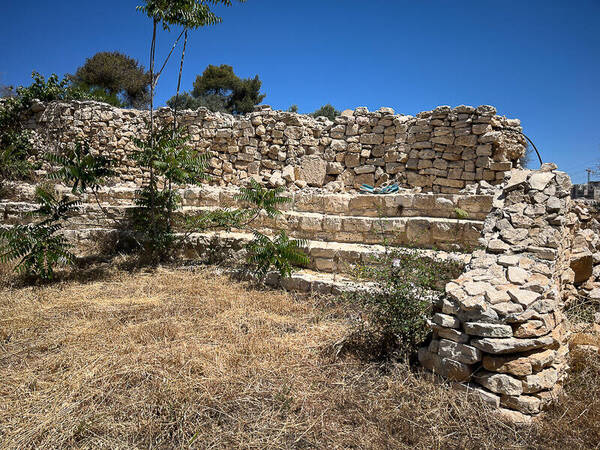
Dr. Fleming: In the late 1980s, as a biblical archaeologist, I was invited, with others, to come to “take a look at Tantur” and especially to investigate some mosaics that had been found there. We discovered that there were many mosaic tiles in the area around what became the “biblical garden”—which supported evidence of a Byzantine-era church or pilgrimage center that existed between the present day “Vineyard Tower” (which I built as part of the Biblical Garden) and the Hermitage. That whole area appeared to be a quarry, where the stones were removed to build this byzantine era structure. My colleague, Dr. Hananiah Pinto, decided that we would like to do more around this site and we were welcomed by the administration of Tantur to come to Tantur.
We discovered a fair amount of pottery and a “Turning” wheel —for making pottery— that dated sometime between 2100-1900 BC—thus showing evidence of habitation in this area at that time. We also found evidence of a cluster of “Mediterranean cypress,” near the “entry gate”—which would have been near the old house at the bottom of the Tantur hill and on the Tantur property.
R: Where was this pottery shard area?
DF: The pottery wheel area was near the remnants of “water pools”. These were actually reservoirs and several other reservoirs existed at the time that we first arrived. They were quite muddy and needed to be cleaned out due to many years of being uncovered and with moss and other “crud” growing in that area. In “biblical days”, these pools/cisterns would have been covered over to “preserve” the purity of the water. Whatever happened to the stone coverings is unknown, but left uncovered, with the sun hitting upon those pools, moss and other stuff would have grown and overtaken the practical use of the water—and would have evaporated the water, leaving the dry pools to the “elements of nature.”
R: It looks like there is a “theater ” in that quarry area. Is that something you created as part of the “garden”?
DF: What presently looks like an “theater” was already there—part of the quarry. I simply cleaned up the area around these pools and quarry and planted many “native” flora and shrubs, including grapevines. I then built the Vineyard Tower to look down upon that pool area. Hopefully the grapevines are still growing on that tower??
R: So those water reservoirs and large cut-outs were there when you arrived?
DF: These water pools below where the Vineyard Tower was built were most likely established around the time of the “quarry” for the Byzantine era church. However, several of these deep water pools had steps going down into them. While others thought that they may have been replicas of “mikvehs”(Jewish ritual baths), I was indefinite about this. I think that as a chapel or pilgrimage site, they were more of a “baptismal” pool since there are steps leading into several of these pools that would have been part of the baptismal ceremony at that time.
There was also a “hoisting” device that was next to a water trough so that it could provide water to other areas around this quarry and church structure. The water came from an intermittent “siphon” spring that flowed there at times. There were several of those springs on the larger Tantur property.
R: Was this quarry area itself the location for this Byzantine era chapel or pilgrimage site?
DF: The small cliff by the pools (and below the Vineyard Tower) would have led up to the Eastern part of the octagonal church built between that cliff and another cliff to the west—quarried out to provide the stone for that structure. There was also evidence of an atrium being in that area of the church as well. The entry would have been near the cliff by the Hermitage (thus allowing everything facing the “east”). The “apse” of this church would have been in that flattened area between where the Vineyard Tower is and the hermitage. This is where mosaics were found as well as further down the hill to the east of the pools, below the “church”.
R: How did it happen that this structure would have been built here?
DF: In that Byzantine era, there were actually 6 of these “pilgrimage sites” established. This one located on the Tantur property was #5 of those 6. Near Mar Elias Monastery, nearby to Tantur, was another structure called “Mary’s Rest” (Kathisma)—which was #4. It was most likely a larger structure than that located at Tantur. #3 was in the area of Ramat Rachel, #2 was in the “Arnona area” and #1 was on the hillside next to St. Andrews Scottish Church. #6 (as yet, not located) was somewhere between Tantur and Bethlehem.
This series of pilgrimage sites would have followed the main route (“the Kings’ Road”) from Jerusalem to Bethlehem (and continuing to Hebron and beyond). It would have somewhat followed the remnants of the “Herod Aqueduct”—which supplied water to Jerusalem from “Solomon’s Pools” just to the south of Bethlehem. While called “Solomon’s Pools”, they were built in Herod’s time. Across the (Hebron) road (to the east) from our Biblical Garden and the Pond areas were the ruins of a Herodian-era Roman “guard house” –adjacent to the “Herod Aqueduct”. While I was there, a modern Checkpoint was established in that area. I don’t know if the ruins of that former “guard station” or the aqueduct are still there.
R: What inspired you to put a Biblical Garden into that area?
DF: As an archaeologist, I’m also interested in scripture and letting archaeology help to inform scripture. I have been interested in creating these ‘scriptural’ gardens to help people today understand what life would have been like ‘way back when’, since there is a connection between the land, living on the land, and scripture. Given the pool areas, the quarry area, and the evidence of a Byzantine era faith structure at this site, I wanted to create something that would attract interest and inform their faith experience. That area of Tantur was perfect for ‘recreating’ something.
Once we cleaned up this area, we planted local flora. We then continued to expand the “Garden” beyond that pool area. Wrapping around that hillside to the south, the garden ‘walk’ led to yet another pool area where a square structure was carved out, in imitation of a “tomb” being carved into the rock–to give an idea of “tomb areas” within a garden. Past that second pool area, we continued the path around a short distance leading to an open area. There we created the “Pond/Lake”. It was just below what is now the Student Center. The pond included an island in the middle, with shrubs, irises, and a tree, so that the ducks I brought could have a “refuge of safety” from predators like the cats, foxes or jackals. Dr. Hananiah Pinto and I would lead tours through the garden and Dr. Pinto’s family (living quite near Gilo, to the immediate west of Tantur) would frequently play there. I also created a “rock-lined stream” that pumped water up from the Pond to the Student Center and which then flowed back down into the Pond, giving the impression of a spring that would feed the pond. Along the stream and the pond, I also planted many “dark purple—almost black—irises”—are they still there?? In addition, I planted cacti, rosemary, lavender, and other flowering shrubs. The larger area was (and I presume still is) surrounded by many olive trees, thus allowing a reflective, quiet, park-like atmosphere.
R: When you came to Tantur, did you live in the main building, one of the apartments, or in the Hermitage?
DF: At the beginning I lived for a year or two in the building beneath the Chapel. It was an easy walk down the hill to that larger quarry area. I then moved into the “Hermitage” (on the hillside below the Tantur Tower) so I could be closer to our work in the “Biblical Garden”. Interestingly, behind the Hermitage, there was a small “house-cave”. I kept tools there along with my donkey, my “beast of burden” in helping to move materials in creating the Garden and the Pond. Many children who came with families to visit that Garden area enjoyed the donkey as well–since we provided “donkey rides”!
The grass in the area between the Biblical Garden and the Pond and Student Center was kept low due to a small flock of sheep I had who would eat the grass and help “fertilize” the area with their “droppings”. Again, the sheep in this biblical garden would be a reminder of the biblical and scriptural nature of the place and that whole area.
Just above that “pond/lake” area was a building, which I understand is now called the Student Center. While I was there, it was empty and so we established a kitchen and dining room area for visitors and workers. What I most enjoyed about that building was the view from the rooftop, so I built a spiral staircase going to the roof. Is it still there and used??
R: It is, indeed! I’m sure that the people in that time you were here enjoyed the tours and the quiet space–as well as picnicking by the Pond. Other local families have mentioned how much they enjoyed that area.
DF: We still have photos, brochures, and a “walking path” guide of the “Scriptural Garden”. We can send them if you wish.
R: Please send!! It is important that we have things like this as part of the history of this Tantur location. Thank you for taking the time to share all of this with me. It is so important to know of your experience, your findings, and your work here at Tantur.
DF: I truly loved being at Tantur, even though I would also be away for 2-3 months teaching or giving lectures abroad (or within Israel) on biblical archaeology. Thank you for letting me share this experience with you.
Various photos follow—of “cisterns”, vinetower, Salameh family enjoying picnic at Lake, flat areas in front of Vineyard Tower


